
Building the AI-Driven Dealership: Lessons from NADA 2026
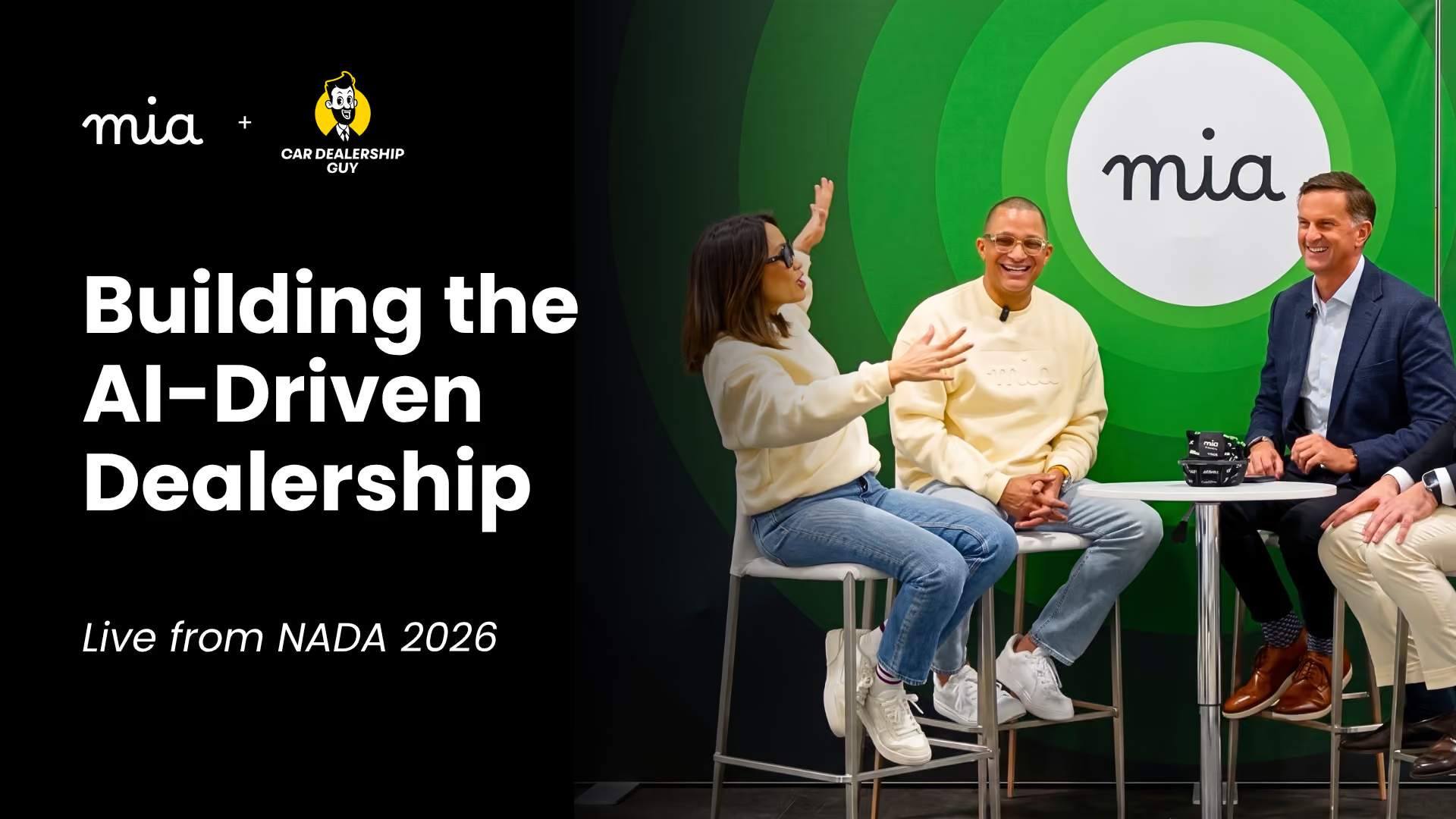
The AI category in automotive is crowded, and it's only getting louder. At the 2026 NADA Convention, dealers were urgently trying to figure out which AI tools are real, which ones are hype, and how to actually put them to work.
To cut through the noise, Car Dealership Guy sat down on the convention floor with Mia's VPs of Sales: Scott Traylor and Thuy Adomitis.
Scott and Thuy covered a lot of ground, including:
- The single fastest way to filter through AI vendors (hint: ask for their CTO)
- Why latency isn't just a tech spec
- What a realistic AI implementation timeline looks like
- What's coming next
If you're a GM, fixed ops director, or dealer principal trying to make a smart AI decision in 2026, this is the conversation to watch.
What GMs are asking about AI
How do I evaluate AI vendors at a trade show like NADA?
Start with one question: can I meet your CTO? If an AI vendor doesn't have a CTO, someone accountable for data security, privacy, and compliance, that's a signal to walk away. Beyond that, ask about latency (the natural pause between speaking and response), whether the system is built on a large language model rather than a decision tree, and whether they carry cybersecurity insurance. And don't just listen to their demo line; call one of their dealer customers and interact in real time.
How long does it take to implement voice AI at a dealership?
A full implementation can take approximately two to three weeks. The process involves connecting APIs, heavy testing, and a phased launch with guardrails in place. Customization and optimization continue in the first 30-90 days, but from day one, the AI is handling real customer interactions.
How should a GM train and manage an AI tool?
A strong AI hire still needs to learn how your store does business, so treat it like a new employee. The most effective GMs take a hands-on approach: they learn the tool themselves, provide active feedback when something goes wrong, and work with their provider to make corrections.
Want to see what Mia could do at your dealership?
The questions dealers asked at NADA aren't really about AI. They're about whether their store is built to meet customers where they are, whenever they reach out. That's the standard Mia is designed to deliver on: every call handled, every appointment booked, every hour the phones are ringing.
Full interview transcript
Host: Hey everybody, welcome to another episode of the Car Dealership Guy podcast. We are here live 2026 at the NADA convention floor. What an exciting time to be at NADA this year. We have two guests with us today: Scott Traylor, VP of Sales, and Thuy Adomitis, VP of Sales, Mia. Welcome to the show.
Scott Traylor: Thanks for having us.
Thuy Adomitis: Thanks for having us, Sam.
Host: What an exciting time to be here at NADA. And you know, this entire North Floor, which by the way is a little bit tougher to find than the West side...
Thuy Adomitis: It is! It's a hike.
Host: It's a hike. But guess what the theme is out here? In my opinion, as I look around, it is AI. It is tech.
And can I tell you something else I've noticed just circulating around the show this year? There is an urgency – it's backed up by the sheer count. I think there's two to three times the number of people here this year than have ever come – there is an urgency by dealers to understand how to protect their business and grow their business in 2026 and beyond. And in doing that, to understand some of the new technologies and AIs that exist.
And I'm interested. Every round table I've been in, every keynote I've done, it's what is the role of this in automotive today, and how do I... there's a little bit of FOMO... how do I not get left behind? And it's interesting to me. I don't know if you see this or not. I think, I've talked a lot about this, the new role of a general manager is to understand AI, to see the good stuff and the bad stuff, learn how to implement it in their business, and then execute with a high ROI. Fair?
Scott Traylor: Yeah.
Thuy Adomitis: Absolutely.
Host: So, but, that's in a world that is enormously crowded. This is really crowded. So let's start there.
How do I as a dealer, February 2026, decide what is good AI, what is bad AI in this marketplace?
Scott Traylor: I think I could start with this. Conversations I've had with dealers and leaders in dealership operations, I try to educate them on, hey, there is a lot of noise. There is a lot of people in this space. How do you differentiate that?
First thing out of my mouth, hey, if they don't have a CTO, if they're not worried and concerned about protecting your customer data, don't even continue the conversation. Customer data, housing the data, data privacy, data security. This is all under that CTO space, you know. And so if you don't have that kind of title in your organization, you're grading, you're trying to gauge this AI company and say is this somebody I want to partner with. I'm saying as a litmus test, first question out of my mouth, can I meet your CTO? And if they don't have one, if they don't have one, just go ahead and move on.
Host: I love that. You were on the show, you've been on our show many times, you've spoken to us about this very topic. What do you say to the dealer or the AI company that says hey, it's not a big deal yet? The federal regulation on safeguards as it relates to AI is not as developed as it is for auto dealerships and how they deal with information in the course of their business like with their DMS provider?
Scott Traylor: Well I mean it is developed. I mean we, we at Mia, we follow the TCPA guidelines to the letter. We had our law firm search, research to make sure that we are going to be compliant with all of our outreach, making sure our opt-ins and opt-outs are recorded. And we're making sure that we're not placing ourselves in danger of being out of pocket with the TCPA guidelines.
But even more so, making sure we're protecting the dealer and the dealer's information, the customer information as well. It's an important question to ask. I've even had dealers ask, hey do you have cybersecurity insurance?
Host: Yeah. Do you?
Scott Traylor: Yeah, of course! 10 million dollars worth.
Host: So, data security, CTO, fantastic tip. Thuy, anything else you would say to look for in great AI tech on this floor here?
Thuy Adomitis: Yeah, so we look for, uh, I would ask about latency. And latency is that pause, right? You talk, then I talk, it's very human-like. And then there's also those interruptions, right? And so you don't want to talk to – the way you talk to the airlines and the banks, it's like over-talking, right? Or decision trees, you want to stay away from some of those and make sure that it's built on a large language model.
Host: So that latency is a great point. And it's fascinating, we talked last time you were on the show about how latency goes to human emotion. And the gold standard for AI voice is being able to elicit that human emotion.
What makes Mia's technology different, Thuy, where it's able to actually elicit a human emotion and engagement where you know you're not calling, and we'll make fun of the airlines because they're an easy target, an airline and you're just like zero zero zero get me...
Thuy Adomitis: Agent agent agent.
Host: Yeah get me out of this hell. Help me out.
Thuy Adomitis: It's an uncomfortable interaction. That is why we bounce out, because there's that pause or she's not answering her questions, or solving that customer's inquiry. Mia's goal is to make sure that customer gets their appointments booked, transferred to the right people, book appointments, do whatever that customer needed to get done immediately.
Host: I guess the big differentiator would be that when you're calling the airline it's a very linear flow.
Thuy Adomitis: It's a decision tree, right.
Host: You can't get out of it.
Thuy Adomitis: Yes, because you can't get out, because if you don't ask the right questions you don't get the right answers and then you're like that's not what I wanted to know. So that plays to the human emotions. I'm not getting my needs met and so our goal is to always make sure that customer's needs are met much better, experience for the consumer, much higher CSI, right?
And we're seeing those adoption numbers rise. So we've got dealer groups that have been on for nearly a year now, right? And so that means they've had a cycle or a couple of cycles of customers come through, and now they've adopted in. They know who to talk to and what we can ask.
Host: What are some of the things that Mia is doing differently than others in the space that are being able to bring that human emotion or that realness to that conversation?
Scott Traylor: There was a large dealer group, he called us up, said I'm sending you an email, you gotta listen to this call. In short, sweet lady, set an oil change appointment but lingered after the call. And Mia said, are you still there? Is there something else I can help you with? And the lady said, if you know how to pray, I'd love it if you'd pray for my grandson. He's in the hospital right now. And Mia answered, “I will keep your grandson in my prayers.” We all lost it.
We've turned a corner. You know, we can leverage this level of technology to fill the gaps inside of dealership operations. And really give customers the connection that they need, the processes that they need, give them the results that they need. And in a manner that they desire. This has never been available to us before. But with these large language models, it's available to us now.
I would also say for dealers that are, you know, at NADA this week, going around trying to test out the latency, trying to figure out who's got the right latency, I would give them this: Don't just listen to the demo calls, call a store.
Host: Yeah.
Thuy Adomitis: Interact live.
Scott Traylor: Yeah, interact live with a store because the demo number, you have to understand, might be on your computer right there. It's a controlled setting. Call a store. Or if you're gonna listen to some calls, listen to calls that came from a store. Live calls that came from a store. So you can really gauge the latency that a customer is gonna receive live.
Host: What's neat about that, if you think about it, is that's an expectation of automotive. You want your employees to connect at that level.
Thuy Adomitis: Absolutely.
Host: But the reality, the practical reality of the economics of automotive, most service writers, most sales people, they don't have the time to stay on the phone that extra 10, 15 seconds and hear that comment and respond to it.
I think part of the FOMO here in automotive today, and all the people here trying to understand this technology, is a knowledge and an awareness that if you don't engage and understand it and adopt it, you're gonna actually get left behind. And there's a CTO of a large auto group who said, look, there are some dealer groups who are out of business already, they don't know it yet, because they're so far behind on adoption. AI is really leveling up the standard of the expectation of service. And it's not something that dealers should compete with. It's something they should collaborate with and learn with.
So you gave us a couple tips of things to look for: CTO, empathy, latency, eliciting a human emotion. When you think about a general manager that just doesn't understand technology, and is trying to like manage this new AI tech, voice AI as an example, what are some tips February 2026 from NADA from Mia to engaging with it, learning it, and then implementing it in your business?
Scott Traylor: So first thing I would say is, at Mia I could say specifically that we've learned a lot of lessons in 2025. The first year was a lot of education. If you're gonna scale a company like this, you're gonna break things. You're gonna fix things. You're gonna take those lessons, make adjustments.
So now that we're two and a half years into this, we’ve learned a lot of lessons. We try to consult with the dealers so that they position Mia in the right place in the workflows. And so here's the truth: You've already tapped into it, but a lot of car guys, guess what, they're not engineers. They're not AI engineers. And that's okay. Just respect that you're not an AI engineer, and let's open up and listen for a little bit so that we can help you help yourself. What happens sometimes is that a dealer operator will want to position a high tech, an AI agent, the way that they think it should play. Without actually asking some questions like hey what does success look like? What have you learned in other circumstances that I can apply at the store?
Thuy Adomitis: We can give them a management course on AI management, right? So the new general managers have to learn on all of these different AIs. So there's going to be a part of their staff is all AI agents.
Host: They're going to have to lead and manage that AI tool. What is a not great response? Pre, post the whole process. What is not a great response is hey I bought this because I understand it, other dealers have said it works, I implemented it, the AI tool gave the wrong answer. The AI tool didn't act or respond in the way it should have. By the way, it happens as you train it, just as it would another employee, right? It doesn't repeat a mistake typically, but you do have to train it.
Talk a little bit about that training piece and how you bring this AI concept, voice AI and others, into the culture of your auto group. What are some tips for GMs on this world today?
Scott Traylor: So first off, when I managed dealerships, the first thing I would bring to that conversation is I literally watched all my employees make that same mistake on the phone. Listening to phone calls, like oh my gosh, why did he, why did she say that? You're gonna have mistakes. It's not the mistake, it's how you handle the mistake.
So we encourage our clients, we need the hard feedback. If you see something, hear something that needs a correction, just like you would have a new staff member, we're going to engage with the local staff and we want to get this feedback extracted from that engagement so we can apply it. So we can get Mia trained up to be a super employee.
Host: I think that's an important distinction though because just like an employee, you're going to have those errors. So when people are coming into AI, especially in this, in voice AI, I think a lot of people are expecting absolute perfection.
Thuy Adomitis: Yes. Absolutely.
Host: That's just not realistic. While you may bring the error percentage way, way down, really close to zero, and again you're not going to be dealing with the human factor right? Tired, sick, in a bad mood. All of that will be gone, so at least you can control these things and retrain it.
Thuy Adomitis: Absolutely. And it's one time, that training, right? So there's going to be some standard customizations, and then you move towards an optimization, right? So first ring, second or third ring. We would love to say work with your provider, give it time. There will be customizations and optimizations. But over time, there's going to be self learning and she's going to end up speaking to every single one of your customers and remembering every single conversation.
Host: What are some other realistic expectations to set for operators in this space?
Scott Traylor: There are some staff members that feel that AI might take my job.
Host: I’ve seen that firsthand. You have employees that sabotage the technology.
Host: And again it's creating a service level expectation by the consumer or educating the consumer that is impossible to deliver by a human today. So humans can back that up and support it, but you can't really compete with it because the level is going up. Is that not right?
Scott Traylor: It is. And I got another take on that. Thuy and I were speaking recently at a conference. There's an expectation of “now” in a consumer... you got your Uber, you got your Uber Eats, you got your DoorDash, you got Amazon Prime. And you get on your cell phone and you buy something that you wanted like an hour later. Or 30 minutes later. Somehow that never gravitated over to the car business, but it's an expectation in literally every consumer in America. 100% every consumer in America.
So it's coming to automotive now. It's here. And this is the message. The AI that we're presenting allows a dealership to be open 24 hours a day, meeting the consumer exactly where they are with that expectation. Which humans can't staff. We can't staff it, it's not feasible for an organization to keep staffers in the house 24 hours a day. But leveraging this technology allows automotive at large to meet that expectation that now that's already in the consumer's brain.
And so we satisfy that consumer's need to be handled, serviced, taking care of at 3 in the morning. And we get a lot of calls. We get a lot of calls after hours. A lot of calls.
Thuy Adomitis: We have some really crafty dealers that market to it as well. Talk to Mia 24/7.
Host: Call us anytime. Create a concierge like experience. If you had a road map or a best practice for a dealer looking to get started today, what can they expect to be delivered? You know, signing a contract with you guys and bringing on board, what's the rollout look like?
Thuy Adomitis: The introduction will be to our client success team or implementation team to get plugged in all of the APIs. We test heavy, introduce you to your engineer. Go live after hours first. Get 'em super comfortable, and then we go to daytime hours, right. And then we start taking those calls in, we continue to optimize over the next month or so. It takes about 3 to 4 weeks right now to do it perfect.
Host: What would you do with a perfect employee after 3 weeks?
Host: That'd be awesome.
Thuy Adomitis: It'd be great.
Scott Traylor: You know, we were even talking about this yesterday, but if you hired a rockstar salesperson or a rockstar service advisor, been in the industry 8, 10 years whatever, put up money at another store. When they come into your store, they have to learn how you do business.
Host: So part of the excitement, part of the engagement here at 2026 NADA, part of the attendance I think is driven by just the sheer speed of AI development since the last NADA which arguably was 2 years ago if you skip past New Orleans.
Looking ahead a year, maybe last question. What do you expect? What do you see coming up next, right? Voice AI, if you think about where it was 2 years ago, completely different place than it is today. What's the next thing dealers should be thinking about?
Scott Traylor: We're dropping call tracking, which is similar to what you have in the dealership right now, for analytics, recording all the calls, analyzing all the calls. It's just that we don't think it needs to have a comma in that price. And so when we look at the legacy players in this space that have been doing it for quite some time, we see ripe opportunity for us to come into that space and optimize for our dealers. And give them a similar product, if it's better, with score cards and everything else that they desire. But at a cost that actually makes sense for this actual feature.
Host: I'll tell you, so we as dealers appreciate the idea of like managing the cost side. So a lot of these solutions and technology, once they're stood up, there's not a lot of additional expense behind it. And I think you're going to see that over the coming year. Less vendors, less suppliers, and more, you know, asking to do more with less, so.
So, Scott, Thuy, we appreciate both of you being on the Car Dealership Guy show. Great, great time being here at NADA 2026 and uh you know again as you think about going ahead all the things you listed it'll be exciting to join you again next year 2027. But let's get through this one first, right? Thank you so much. Good to see you guys.
Scott Traylor: Thank you.
Thuy Adomitis: Thank you so much.